
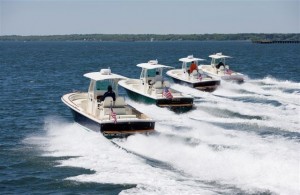

Lew Beers loved his Hunt 25, so when it came time to go a little bit larger, the choice of brands was obvious.
By Peter A. Janssen
When it came time for a new boat, Lew Beers knew exactly what he wanted: the same thing, but with a bit more elbowroom. An executive with MetLife in Boston, Beers started boating in a 23-foot center-console and then moved up to a Hunt 25 Surfhunter. He and his wife Carolyn spent summers taking the boat from a pond near their home in Charlestown, Rhode Island, around Narragansett Bay and over to Block Island for day trips. "But we wanted to spend the night, and we wanted a stand-up head with room for a shower," he says. "We needed a bigger boat."
After doing the usual round of boat shows and other research, Beers ended up pretty much where he started; three years ago he traded up to a Hunt 29 Surfhunter with a jet drive. "The entrance to the pond where we keep the boat is only 2 feet deep at low tide," he says. "We wouldn't be able to keep a 29-footer there if it weren't for the jet." Just as important, however, was his loyalty to the Hunt brand. "Our experience with the 25 was so good we felt comfortable moving up to the 29," Beers says. "They did everything we asked. They're fantastic to work with, and they have great customer service."
With the 29, the Beerses also take longer voyages. There are still the trips to Block Island, because it's nearby, but last summer they went down to New York City and saw the Statue of Liberty and then cruised up the Hudson River to Troy, New York. "We loved every minute," Beers says. "We met up with some friends on a trawler, and they stopped halfway up. We were having so much fun, we just kept going." This summer they're looking forward to heading up to the Cape Cod Canal and also over to Martha's Vineyard.
Beers is happy with the Hunt's performance and looks. "It's a pretty boat," he says. He laughs when he explains its name: Summer Salt. "That's a play on words," he says. "First, it's a salty-looking boat. But then, a somersault is what we'd have to do if we have a problem getting out of our pond
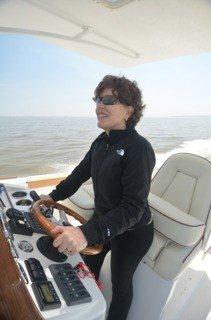
This just in from the Robinson's who took possession of their SH25CC several weeks ago.
We continue to get compliments and inquiries as to what our boat is every time we go out. Moored in a cove off Gibson Island Saturday evening, a tasteful vessel came alongside and the skipper told me we had the best looking boat in the anchorage (up against some pretty stiff competition) as well as the best looking crew. Even if he had had a few margaritas by then, that was still pretty good.
Yesterday afternoon, moored for lunch in Luce Creek up the Severn, another boat came alongside. The captain asked what we were, complimented us and even remembered seeing us dock the previous evening in the dark back at AYC. I hope that was more a function of the Hunt design rather than our docking skills.
Read More
We continue to get compliments and inquiries as to what our boat is every time we go out. Moored in a cove off Gibson Island Saturday evening, a tasteful vessel came alongside and the skipper told me we had the best looking boat in the anchorage (up against some pretty stiff competition) as well as the best looking crew. Even if he had had a few margaritas by then, that was still pretty good.
Yesterday afternoon, moored for lunch in Luce Creek up the Severn, another boat came alongside. The captain asked what we were, complimented us and even remembered seeing us dock the previous evening in the dark back at AYC. I hope that was more a function of the Hunt design rather than our docking skills.
We have just returned from 3 phenomenal boat shows where we met many new Hunt admirers, had a chance to catch up with our owners and fans and witnessed a healthy response from the marketplace ready to buy their first or next boat. Here' s a great clip of our participation in the Annapolis Boat Show.
Read More
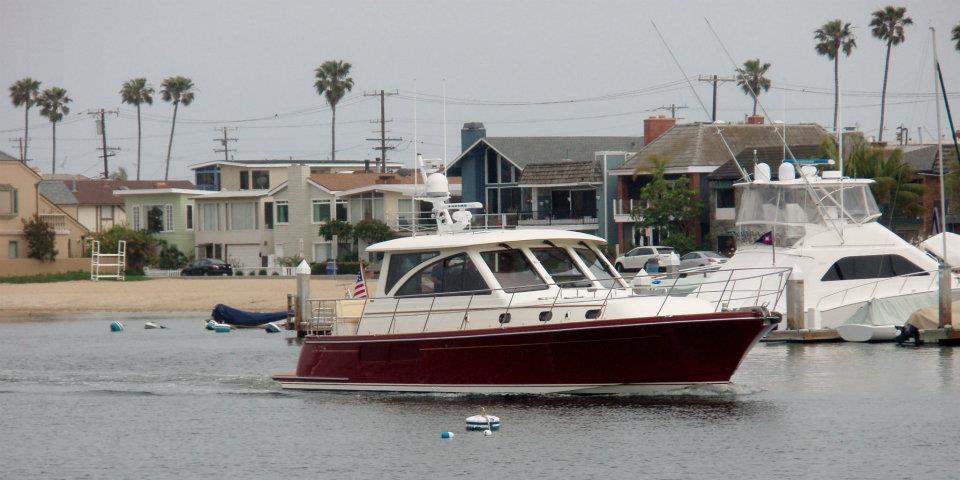
"I was operating a vessel in Newport Harbor, California on Sunday and shot these pictures while underway of a Hunt Yacht. This may be the only Hunt 52' Express in Southern California. I'm looking forward to seeing more of your yachts on the water here in Southern California." - Thanks for sharing Capt. Poster
Read More
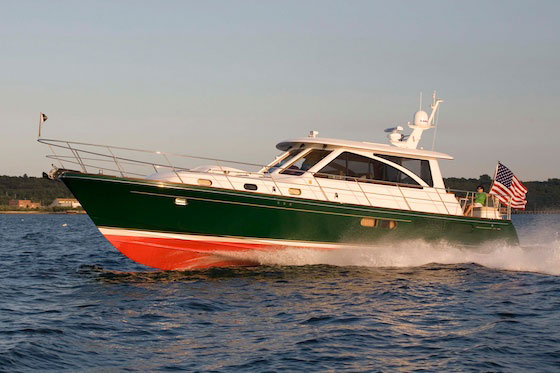
Hunt 52 IPS: What’s the Difference?
How does a good-sized yacht yacht differ when it's powered by pod drives? I learned a lot on a recent ride aboard an IPS-rigged Hunt 52.
Article No. 1 in a series about the Proven Performance of Hunt hulls. This article addresses several myths published about the deep-V and provides tested truths about the newest generation of deep-V hulls.
It’s also important to understand that hard chine boats are generally more stable than round bilged boats. This is because the hard edge of the chine is more resistant to rolling than a nice soft round edge. A hard chined boat equal in waterline beam to a round bilged boat will be stiffer.
Static stability is only part of the picture however. Another component in planing boats is dynamic stability. And it is an important one. The same forces that lift a planing boat above the water also stabilize the boat and counteract rolling. Displacement boats have no such benefit, thus the need for fin stabilizers and flopper stoppers. Planing boats gain stability once on plane. They actually are stiffer running at speed. The deep-v has the added advantage due to the deadrise because the planing forces are always working to right the boat. These forces are acting normal to the surface of the hull through the center of lift. On flat bottomed hulls these forces are acting normal to the bottom also, but do not counteract a roll.
A few years ago Grady White asked us to design some planing catamarans. We looked at a lot of catamaran hulls and seatrialed many before we designed the Grady cats. We discovered that the same speeds were attained by mono-hulls and catamarans if the weights and horsepower were equal.
The major factor in efficiency and speed is weight. Heavy boats are slower and need more power. Deadrise has little effect on efficiency when looking at real boats in the water as opposed to theoretical tests. So many other factors can make a much bigger difference. Compare for yourselves. Look at the boat tests in the magazines. Even if these are not the most scientific, they can be used for comparison. Compare the fuel efficiency of Hunt Yachts to other boats, and you will see we are as good as or better than most. Also note that planing hulls don’t have to be any less efficient than displacement hulls.
We put the ride first and the housekeeping second, so on the unpredictable ocean, you will be comfortable and confident at all times, in all seas.
Read More
TRUTH: Today’s deep-vs do not roll any more than flatter bottoms of the same beam.
At-rest or static stability, is largely dependant on vertical center of gravity and waterline beam. Early deep-vs were designed to float with their chines clear of the water for speed, so they were narrow at the waterline, skinny, for more speed. The Bertram-31 and others of that vintage were light and fast for their time but did roll from chine to chine when at rest in a beam sea. Today we address that problem by designing each hull to have its chine in the water at rest for about half of its waterline. This creates a wider beam on the water and and a stable boat. Today’s deep-vs do not roll any more than flatter bottoms of the same beam.It’s also important to understand that hard chine boats are generally more stable than round bilged boats. This is because the hard edge of the chine is more resistant to rolling than a nice soft round edge. A hard chined boat equal in waterline beam to a round bilged boat will be stiffer.
Static stability is only part of the picture however. Another component in planing boats is dynamic stability. And it is an important one. The same forces that lift a planing boat above the water also stabilize the boat and counteract rolling. Displacement boats have no such benefit, thus the need for fin stabilizers and flopper stoppers. Planing boats gain stability once on plane. They actually are stiffer running at speed. The deep-v has the added advantage due to the deadrise because the planing forces are always working to right the boat. These forces are acting normal to the surface of the hull through the center of lift. On flat bottomed hulls these forces are acting normal to the bottom also, but do not counteract a roll.
TRUTH: There is not much difference in speed between well designed planing hull shapes.
MYTH: “DEEP-VS ARE HARD TO PUSH” – This is another old tale that we can surmise comes from the generality that most deep-vs are highly powered to go fast so they use a lot of horsepower. Any boat trying to go fast requires a lot of power. We do not see much variation in efficiency from hull to hull if we compare boats of similar dimensions and weight. Differences in hull shape, beam, chine shape, struts, rudders, propellers, all those things together do make a difference, but overall, there is not much difference in speed between well designed planing hull shapes. Note the emphasis.A few years ago Grady White asked us to design some planing catamarans. We looked at a lot of catamaran hulls and seatrialed many before we designed the Grady cats. We discovered that the same speeds were attained by mono-hulls and catamarans if the weights and horsepower were equal.
The major factor in efficiency and speed is weight. Heavy boats are slower and need more power. Deadrise has little effect on efficiency when looking at real boats in the water as opposed to theoretical tests. So many other factors can make a much bigger difference. Compare for yourselves. Look at the boat tests in the magazines. Even if these are not the most scientific, they can be used for comparison. Compare the fuel efficiency of Hunt Yachts to other boats, and you will see we are as good as or better than most. Also note that planing hulls don’t have to be any less efficient than displacement hulls.
TRUTH: Not all Deep-V's are the same.
The Hunt deep-v is the original, and it also has evolved. While it is still very similar to Ray’s original concept, we have improved it and tailored it for every application from 10 ft. PWCs to 110 ft. Motoryachts. Our 50 years experience has taught us how to make it better. If you look closely at hulls at a boat show or boatyard you can easily pick out a Hunt hull. Our hulls have more deadrise forward, finer waterlines, robust and sharp edged chines and strips, and generous flare. Many other hulls carry transom deadrise too far forward giving a harsher ride, let interior accommodations define hull shape above and below the waterline, have soft easily molded chines and strips that are far less effective in knocking down spray and holding the boat steady at sea.We put the ride first and the housekeeping second, so on the unpredictable ocean, you will be comfortable and confident at all times, in all seas.
TRUTH: Less Deadrise is not necessarily better at slower speeds.
Deadrise is less important than other critical charateristics, notably the run and buttocks lines aft, the right propeller/gear ratio match, trim and weight. Deep-vs make superb displacement boats. With more hull and displacement under the water than flat bottomed boats, they handle better, go straighter with less effort, and can be more stable than traditional displacement hulls due to the hard chine.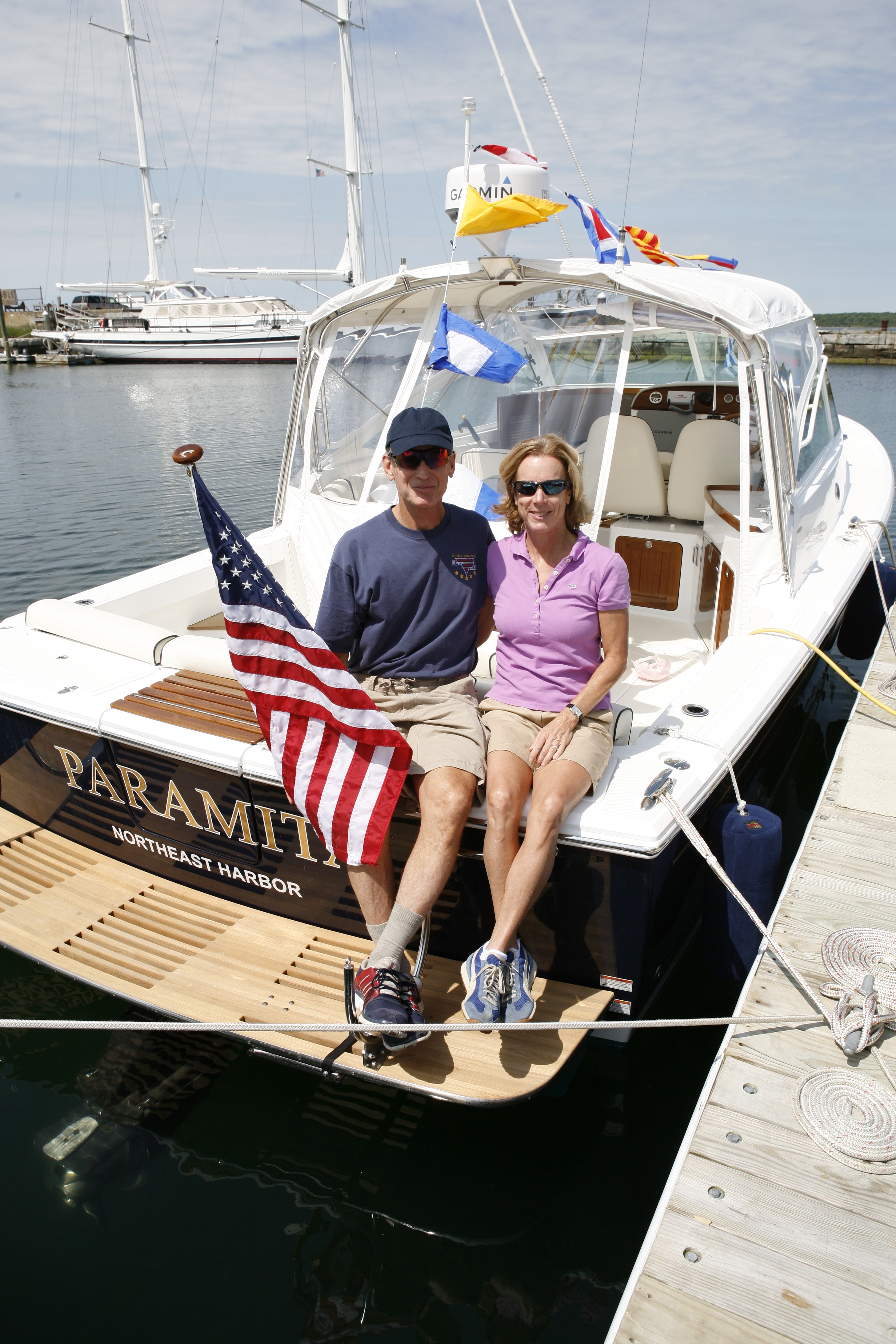
Hunt Harrier 29 "Paramita" gets ready for her trip home to Northeast Harbor Maine
Read More

- Paramita and her passengers enjoying Maine serenity
-
Chris Labozza I had the pleasure of finally seeing the 44 in Lauderdale, and I have to applaud the entire team at CR Hunt for producing such an incredible machine. The 52 blew me away when it debuted, but the amount of boat that was fit into the 44 with not one small detail forgotten, just reaffirms Hunt's position as THE top builder in the United States. From the Surfhunter, Harrier, and the Express series, with all the various propulsion packages and custom options, each built on such an incredible sea-conquering hull, Hunt deserves every bit of praise for such craftsmanship. As an FYI, I am not in any way affiliated with the company, just a wharf rat who has seen enough boats to give credit where credit is due. Keep up the great work, can't wait to see that 68!
Read More